Your FYP Is Now a Film Degree: How TikTok Turned a Generation Into DIY Directors
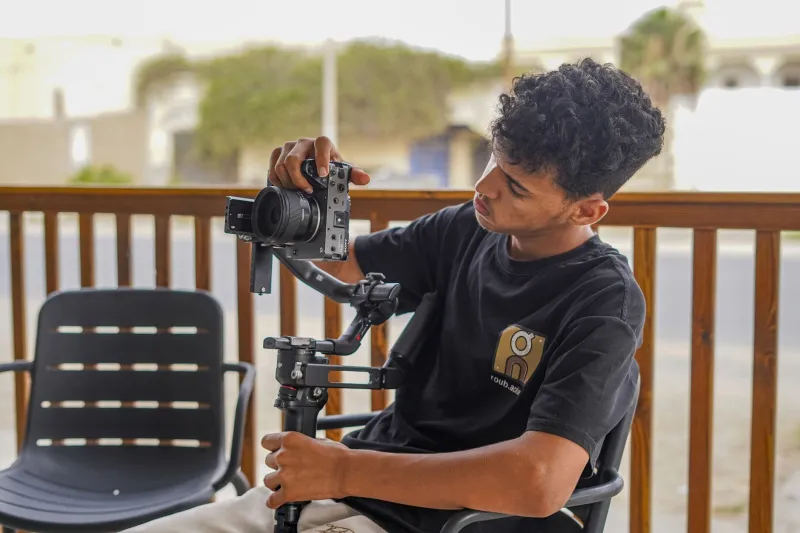
Somewhere in a one-bedroom apartment in Austin, a 22-year-old named Marcus is color grading his third short film of the month. He's never set foot in a film school classroom. His education happened on TikTok, YouTube rabbit holes, and a $300 mirrorless camera he bought secondhand on Facebook Marketplace. He has 400,000 followers. He just got a call from a production company in LA.
This is not an anomaly. It's a pattern.
The traditional film school pipeline — NYU, USC, AFI, Chapman — used to be the gatekeeping mechanism for who got to call themselves a filmmaker. You paid the tuition, you suffered through the theory courses, you made your thesis film, and then maybe, maybe, you got an entry-level PA gig if you networked hard enough at the right festival. That model is cracking at the seams, and Gen Z is the reason why.
The Algorithm as Mentor
TikTok's short-form format has done something genuinely unexpected: it's created an incredibly demanding training environment for visual storytelling. When you have 15 to 60 seconds to hook a viewer who has infinite other content one swipe away, you develop instincts fast. You learn what works through raw, immediate feedback — not a professor's notes, but hundreds of thousands of real human reactions in real time.
Creators like Jade Ellison, a 20-year-old from Atlanta who amassed over 600K followers making micro-horror clips, describe the process as "failing publicly at speed." Her first videos bombed. She watched the analytics, adjusted her pacing, changed her sound design approach, and tried again. Within eight months, she was getting DMs from short film producers.
"Film school teaches you the rules," Jade told us over a video call. "TikTok teaches you whether your instincts are any good. Those are different things, and honestly, I needed to know the second one first."
This trial-by-algorithm approach has produced a generation of creators who are technically sharp in ways that genuinely impress industry veterans. Cinematography, editing rhythm, sound mixing for mobile — these skills are honed through repetition in a way that classroom exercises rarely replicate.
What the Algorithm Doesn't Teach
Here's where the conversation gets complicated, and where film school traditionalists have a point worth taking seriously.
Algorithmic storytelling is built around the hook. The first three seconds. The retention curve. The payoff that makes someone share. These are real storytelling skills, but they're optimized for a very specific kind of engagement — one that doesn't necessarily translate to a 90-minute feature or even a 20-minute short film with genuine narrative architecture.
Three-act structure, subtext, character interiority, thematic coherence across a long-form work — these are muscles that TikTok doesn't really exercise. Several creators we spoke with who had transitioned into professional production work admitted that their first experiences writing full scripts felt like "trying to run a marathon when you'd only ever sprinted."
Derek Cho, a 24-year-old creator-turned-director who recently wrapped his first funded short film, was candid about the gap. "I knew how to make something feel cinematic in 30 seconds. Sustaining that for 15 minutes without the crutch of a trending sound or a jump cut every two seconds? That took me a minute to figure out. I had to basically re-learn patience as a storytelling tool."
This isn't a knock on the TikTok path — it's an honest accounting of what it does and doesn't develop.
The Democratization Argument
The more politically charged question is whether this shift is genuinely opening doors or just replacing one set of gatekeepers with another. Film school has always been, at its core, a class issue. The cost alone locks out enormous swaths of talented people, and the cultural capital required to even consider applying to USC's MFA program skews heavily toward kids who grew up in households where "filmmaker" was a plausible career aspiration.
TikTok, for all its algorithmic chaos and corporate weirdness, is free. The tools are increasingly affordable. The audience is massive and genuinely diverse. A Black teenager in Birmingham, Alabama with a $200 phone has a real shot at building an audience and developing skills in a way that simply didn't exist 15 years ago.
That matters. A lot.
But the film industry's response to this talent pool has been uneven. Some production companies are actively scouting TikTok for visual storytellers with strong aesthetic instincts. Others are dismissive, viewing short-form creators as content machines rather than filmmakers. The bias toward credentialed training persists in certain corners of the industry in ways that are hard to shake.
A Different Kind of Film Education
What's emerging isn't really a replacement for film school so much as a parallel track — one that's messier, faster, and more self-directed, but also more accessible and in some ways more honest about what the industry actually demands.
The creators making the most successful transitions aren't just TikTok-brained content machines. They're the ones who recognized their own gaps and filled them deliberately — reading screenwriting books, studying long-form films obsessively, collaborating with writers who could help them develop narrative depth.
The DIY path, at its best, produces filmmakers who are hungry, resourceful, and already audience-tested. At its worst, it produces technically slick creators who mistake aesthetic polish for storytelling substance.
The honest answer is that both paths can produce either outcome. Film school doesn't guarantee you'll graduate with anything worth watching, and TikTok doesn't guarantee you'll stay stuck making 30-second loops forever.
What's different now is that the choice exists. And for a lot of kids who never would have gotten through the door otherwise, that choice is everything.